
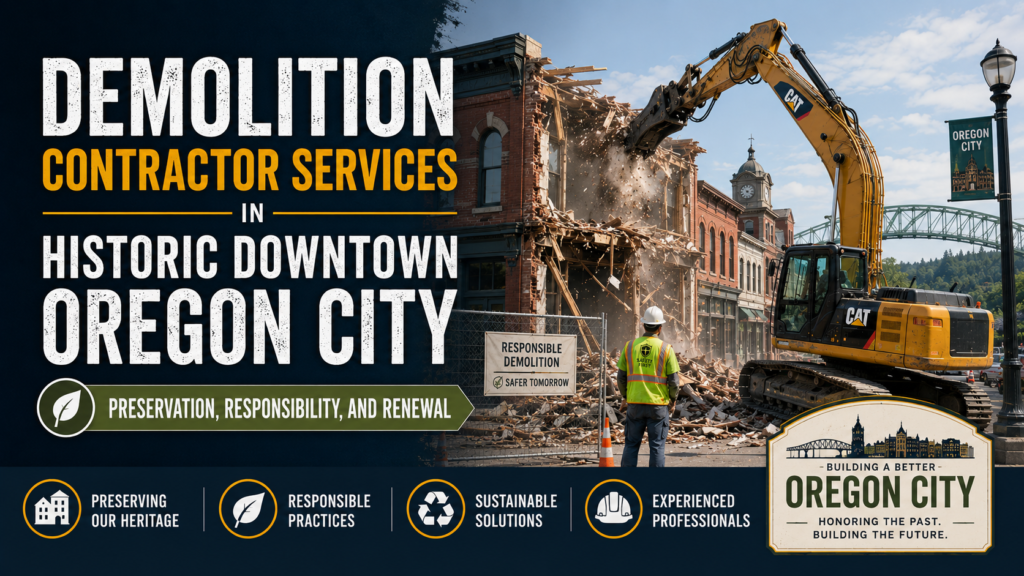
Downtown Oregon City holds a place of singular importance in American history. Founded in 1829 by Dr. John McLoughlin of the Hudson’s Bay Company, Oregon City was incorporated in 1844 as the first city west of the Rocky Mountains. It served as the territorial capital of Oregon from 1849 to 1852, and as the final destination of the Oregon Trail the western terminus where hundreds of thousands of pioneers completed their transcontinental journey between 1841 and 1869. Downtown Oregon City is built along the east bank of the Willamette River, just downstream from Willamette Falls the most powerful waterfall by volume in the Pacific Northwest which powered the city’s early mills and, in 1889, generated the first long-distance electrical transmission in North American history.
Today, the historic downtown encompassing the McLoughlin Historic District and the core of Oregon City’s commercial and cultural life along Main Street and its surrounding blocks is a place of active revitalization. New restaurants, breweries, and boutique businesses are bringing life back to historic storefronts. The Willamette Falls Riverwalk project is transforming the waterfront. Residential density is increasing as infill development and adaptive reuse projects reshape underutilized parcels. This evolution creates both opportunities and responsibilities for Demolition Contractor Historic Downtown who work in this uniquely significant urban context.
Demolition in a Historic District: A Different Kind of Work
Demolition contracting in a historic downtown environment is fundamentally different from demolition in a typical suburban residential or commercial context. Historic districts are defined by their architectural and historical fabric the collection of buildings, structures, streetscapes, and spaces that together convey the character of a place over time. In Oregon City, the McLoughlin Historic District includes hundreds of architecturally and historically significant properties that are protected under local historic preservation ordinances and Oregon’s State Historic Preservation Office (SHPO) regulations.
When demolition work is planned in or near a historic district, a series of regulatory steps and professional considerations apply. The Oregon City Planning Division requires review of proposed demolitions that affect designated historic landmarks or properties within historic resource overlay zones. Demolition of historic landmarks requires approval through a formal Demolition Review process. Even for non-landmark structures, demolitions near historic resources may be subject to notification requirements, delay periods, and compatibility review for any replacement construction.
Demolition contractors working in Historic Downtown Oregon City must be knowledgeable about these requirements and must plan their work accordingly. Proceeding without proper approvals or failing to comply with historic preservation regulations can result in significant legal and financial consequences for property owners and contractors alike.
Types of Demolition Work in Historic Downtown Contexts
Selective Interior Demolition: The most common type of demolition work in historic downtown areas involves the interior of historic buildings that are being renovated, adaptively reused, or upgraded. Interior selective demolition removing non-original walls and partitions, stripping out deteriorated mechanical and electrical systems, demolishing suspended ceilings to reveal original structural elements, removing inappropriate finishes to expose original masonry or woodwork is a delicate, skilled process that requires understanding which elements are original and historically significant and which are later additions that can be removed without compromising the building’s integrity.
Experienced demolition contractors approach interior work in historic buildings with investigative curiosity and documented processes. Unexpected discoveries are common original flooring beneath later overlays, structural systems different from what drawings suggested, or previously hidden architectural details of historic significance. Proactive communication with property owners, architects, and preservation planners when such discoveries occur is a hallmark of professional work in historic settings.
Structural Selective Demolition: More complex selective demolition involves the removal of structural elements walls, floors, roof sections within historic buildings. This work requires engineering analysis to understand the structural consequences of removing specific elements, temporary shoring and bracing to maintain stability during removal, and precise execution to avoid unintended damage to adjacent historic fabric. In Oregon City’s historic downtown, where masonry buildings from the 1880s through the early twentieth century are common, structural demolition requires particular expertise in the behavior of unreinforced masonry and historic timber framing.
Full Structural Demolition of Non-Contributing Structures: Not every structure in or near a historic downtown is historically significant. Non-contributing structures buildings that are too recent, too altered, or too deteriorated to convey historic significance may be cleared to make way for infill development, parking, or open space without triggering the same level of review as contributing historic resources. Demolition contractors must understand the distinction between contributing and non-contributing structures within historic districts, and must confirm a structure’s status before proceeding.
Emergency Stabilization and Structural Hazard Removal: Older buildings in historic downtown areas sometimes present emergency structural hazards severely deteriorated walls, failed roof systems, collapse-risk facades that require urgent intervention. Demolition contractors may be called upon to perform emergency shoring, partial demolition of imminently dangerous components, or structural stabilization to prevent collapse. Emergency work in historic districts still requires coordination with local authorities and, where time permits, with historic preservation planners, to ensure that emergency interventions do not cause unnecessary loss of historic fabric.
Hazardous Materials in Historic Buildings
Oregon City’s historic downtown includes many buildings constructed in the late nineteenth and early twentieth centuries, when construction materials now known to pose serious health hazards were standard practice. Asbestos-containing materials are pervasive in this building stock: pipe and boiler insulation, floor tiles and mastics, roof materials, joint compound, and acoustical finishes may all contain asbestos depending on the building’s construction and modification history. Lead-based paint is nearly universal in pre-1978 buildings. Older plumbing systems may contain lead solder. Oil tanks for heating fuel may still be present in basements or buried adjacent to older commercial buildings.
Before any significant demolition or renovation work begins in a historic downtown building, a thorough pre-construction environmental survey is required. Licensed asbestos inspectors and environmental consultants identify the presence and condition of hazardous materials, and licensed abatement contractors remove them in compliance with Oregon DEQ and federal EPA standards. This abatement work must be completed before mechanical demolition begins, and documentation of abatement completion is typically required as a condition of demolition permitting.
Protecting Adjacent Properties and Public Safety
Historic downtown buildings are often built directly adjacent to one another sharing party walls, closely spaced foundations, and interconnected utility infrastructure. Demolition in this context requires extraordinary care to avoid damaging neighboring structures. Party wall conditions must be assessed by a structural engineer before work begins. Shoring and bracing systems must be designed and installed to transfer loads that may be disrupted when a shared wall is removed. Vibration monitoring may be appropriate during mechanical demolition near sensitive neighboring structures.
Public safety in an active historic downtown environment is also a paramount concern. Demolition sites in densely used urban areas must be secured with appropriate fencing, scaffolding, and overhead protection to protect pedestrians and passing vehicles. Dust suppression is essential to maintain air quality and visibility on adjacent sidewalks and streets. Traffic management may be required to route pedestrians and vehicles safely around active demolition work. Professional demolition contractors develop comprehensive safety plans before beginning work in urban historic downtown environments.
Demolition and the Future of Historic Downtown Oregon City
Oregon City’s historic downtown is in the midst of a renaissance. Willamette Falls long hidden behind industrial buildings is becoming accessible to the public through the ambitious Riverwalk project. New food and beverage establishments are breathing life into historic storefronts. Infill housing is being developed to increase residential density in the heart of the city. The Oregon City Municipal Elevator the only vertical street in the United States continues to connect the lower downtown with the blufftop neighborhoods above, drawing visitors and residents alike to experience the city’s remarkable topography and history.
In this context, the role of the demolition contractor is one of thoughtful stewardship. When historic structures are cleared to make way for new development, the demolition must be conducted with respect for what is being lost with hazardous materials properly managed, with neighboring buildings protected, with salvageable historic materials documented and potentially preserved, and with the site returned to a condition that is ready to receive new investment of the highest quality. When historic buildings are being renovated and adapted for new uses, the selective demolition work must be precise enough to preserve what is historically significant while creating space for new programming and infrastructure.
Oregon’s Regulatory Framework for Historic Demolition
Oregon’s State Historic Preservation Office (SHPO), working under the State Historic Preservation Act, establishes state-level regulations for the treatment of historic resources. At the local level, Oregon City’s planning code establishes the Historic Preservation Overlay District, which governs alterations, demolitions, and new construction affecting designated historic landmarks and contributing resources within historic districts. The city’s Historic Review Board plays a key role in reviewing applications involving historic resources and making recommendations on proposed demolitions.
In Clackamas County, the broader regulatory framework governing demolition includes Oregon DEQ requirements for hazardous material management, Oregon OSHA safety requirements for demolition worker protection, and local building department permitting requirements. Demolition contractors working in Historic Downtown Oregon City must navigate this multi-agency regulatory landscape competently and proactively, ensuring that all required reviews, approvals, and notifications are in place before work begins.
The Value of Local Experience in Historic Downtown Demolition
Demolition contractors with deep experience in Oregon City and the greater Portland-metro area bring invaluable local knowledge to historic downtown projects. They understand the construction technologies common in Oregon City’s historic building stock the brick masonry, timber framing, and early concrete construction that define the city’s architectural character. They have established relationships with local structural engineers, environmental consultants, and preservation planners who are essential collaborators on complex historic downtown projects. And they understand the community’s deep attachment to its historic downtown a place that has been central to Oregon’s identity since before Oregon was a state.
Conclusion
Historic Downtown Oregon City is one of the Pacific Northwest’s most significant urban places a living testament to more than 175 years of American history, natural power, and community resilience. Demolition contractors who work in this environment carry a responsibility that goes beyond the technical: they are stewards of a built environment that connects Oregon City’s residents and visitors to the deep currents of American history. Whether performing careful interior selective demolition in a nineteenth-century commercial building, clearing a non-contributing structure for new infill development, or providing emergency stabilization for a structurally compromised historic facade, professional demolition contractors in Historic Downtown Oregon City bring expertise, regulatory knowledge, and respect for context to every project they undertake.